
I’m sitting here staring at the blank screen today, but it’s not because I have writer’s block. On the contrary, I feel like I may be suffering from quite the opposite! I just spent a week at the FEMA Center for Disaster Preparedness in Anniston, Alabama. They have a multitude of classes there, so I am already wondering what I should take when I go back! This time around I learned about the Hospital Emergency Response Team, which can be activated by a hospital during a Mass Casualty Incident.
I left New York City on Sunday morning and got to Atlanta Airport around noon. From there the CDP came and picked us up in big buses for the almost two hour drive to Anniston. I’m always so surprised by the sheer multitude of space in the south. At one point I saw a building for a dentist office and then after a long time of trees and things, a building for an eye doctor. In NYC, those two probably would have shared offices on the first floor of a twenty story apartment building as well as a few other businesses… oh and the rent would have been double.
We stayed in housing that used to be a military base with quite a history. They apparently used to try to dispose of some pretty hazardous material on this base. I was told not to drink the water, but I’m fine. *twitch twitch* The week was heavily organized, which spoke to my love of efficiency. Our schedule was followed to the minute! In the morning, the buses would come pick us up at a designated time and take us to the Noble Hospital Training Facility. This building is basically used as a training hospital. There is an ED with six trauma bays (mostly areas of the room), multiple different units and ICUs. During our simulations, they even had a place for Public Health to be as well as a spot for the Public Information Officer to be interviewed by the media.
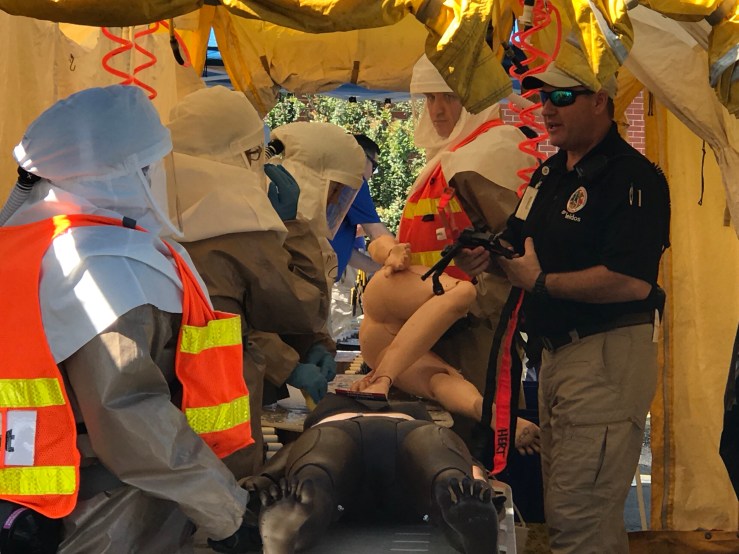
The first three days, we learned about HERT or the Hospital Emergency Response Team. We went through lectures about the many moving parts of the team from the National Emergency Response, HICS and Personal Protective Equipment to the Health Effects of CBRNE (chemical, biological, radiological, nuclear and explosive), Decontamination, Triage and much more. I went into the classroom like a sponge and tried to soak up any and all information that would be put in my direction. I love to learn but it was the hands on training that was my favorite part. On Tuesday morning we put on our Level C Personal Protective Equipment or PPE and went outside to do Lanes Training. In our small groups, we went through each section of the Emergency Treatment Area that would be set up outside a hospital in the event HERT is activated. These areas include Triage, Nonambulatory and Ambulatory Decontamination (as well as Technical Decon for the staff), Survey and Monitoring, Treatment which culminates with transport into the hospital. After our Lanes Training, we took off our PPE and then Demobilized the Emergency Treatment Area so that we could set it up the next day. I volunteered to be Water and Electric so that I could learn how to set up the water as well as the run-off of water from the decontamination area. Think about it… if we are washing a chemical agent off of these patients, then we can’t just let it go into the drains, we have to collect that water for disposal. It’s a very intricate and specific process with a lot of cogs and wheels.
On Wednesday, they let us do a small run through of what an actual event might be like. This was our “get the feet wet” training before our final day that would include our Integrated Capstone Event, or ICE Training. They sent us about 40 patients that day, and they promised about 100 on Friday. What did we learn? Well the first thing that usually breaks down any form of organization is communication. There were some people who weren’t used to communicating with radios, and listening to and talking into a radio with PPE on can be quite difficult. So we debriefed afterward and figured out what we could do to fix the issue. It was our first time working as a team of 42 and luckily we were able to find out what worked and what didn’t work.
Thursday we had our “Train the Trainer” day, where we went back through the information again with our wonderful instructors so that we can bring this information back to our facilities and communities. I won’t lie to you when I think about how daunting that sounds to bring this information back and teach it, but I am willing to try. Why go to a training if I am not going to share the information?
After Thursday’s long day of classroom lectures, I made sure to make it an early night and to hydrate well. We knew that “something” was going to happen on Friday morning but we had no idea what that might be. We were picked up by the bus and having a “staff meeting” when a 7.3 magnitude earthquake hit the fictitious town of Noble City, Alabama. The hospital lost power and took a few minutes for the generators to kick in. One of the really neat aspects of Friday’s simulation was that we were paired with the Healthcare Leadership class, so we needed to wait for the Leadership of the hospital to activate us before we set up our Emergency Treatment Area. As predicted, patients started showing up before we were ready so we had them do a Gross Decontamination while they waited for us to be set-up. We were able to set up in under 40 minutes! I was in the Treatment Area for the duration of the four hour simulation. We get the patients after they are done with decontamination and have been given the okay by Survey and Monitoring that there is no more contaminant and no signs of radiation. In our area, we check their triage status to see if the patient needs to be upgraded or downgraded and if they need any life saving interventions. Once those are done, we check in with the emergency department for critical patients and send the walking wounded into the waiting room.
We saw 87 patients on Friday for our simulation! During our Hotwash, or debrief, we heard about the challenges and the triumphs from all sides of the simulation. Leadership had some challenges with discharging patients that were in the hospital before the earthquake as well as what to do with patients who needed to come to the hospital but were nowhere near the incident. Our challenges were resources like stretchers and plastic bags for patient belongings, but all in all, we ran the simulation pretty smoothly. Doing a drill like that to that magnitude was really very fascinating, and I had wished that we had more time during the debrief to go over other minor issues. For example, one of the role players made it through decontamination with a bag of emesis and tried to hand it to one of our crew in the treatment area. The problem with that is that the Treatment Area is supposed to be a clean area, so we had to make sure not to contaminate our section. The goal of HERT is to keep any contaminates from entering the hospital or contaminating the workers because there are so many patients per resources and workers, we have to make sure to take care of our staff because they are needed. We were able to contain the situation and learn a valuable lesson in the process!
I feel like I could go on and on about this experience! But now it is time for next steps. I’m joining the Mass Casualty Incident team in our hospital and it looks like I’ll be the one bringing this information out to the front line staff. I’m excited and grateful that I was able to take part in this opportunity.
“LEARNING IS NOT ATTAINED BY CHANCE, IT MUST BE SOUGHT FOR WITH ARDOR AND ATTENDED TO WITH DILIGENCE.”
―ABIGAIL ADAMS

 Mar Tells Mini Tales
Wow! That was interesting. We have done emergency drills for earthquakes before in Facilities Management. I wonder if hospitals usually involve Facilities Management in their drills. You would think Facilities would be the ones catching the contaminated water rather than a skilled nurse. Why don’t they take groups like you to the immigration centers to check on the immigrants and see what health issues they have? That would be a for real training. You do great work! Thanks for helping to save the world.
Have fun at Comicon! Send me lots of photos! Which day are you wearing Captain America?
On Tue, Oct 1, 2019 at 10:52 AM Mar Tells Mini Tales wrote:
> Maryann posted: “I’m sitting here staring at the blank screen today, but > it’s not because I have writer’s block. On the contrary, I feel like I may > be suffering from quite the opposite! I just spent a week at the FEMA > Center for Disaster Preparedness in Anniston, Alabama.” >
LikeLike